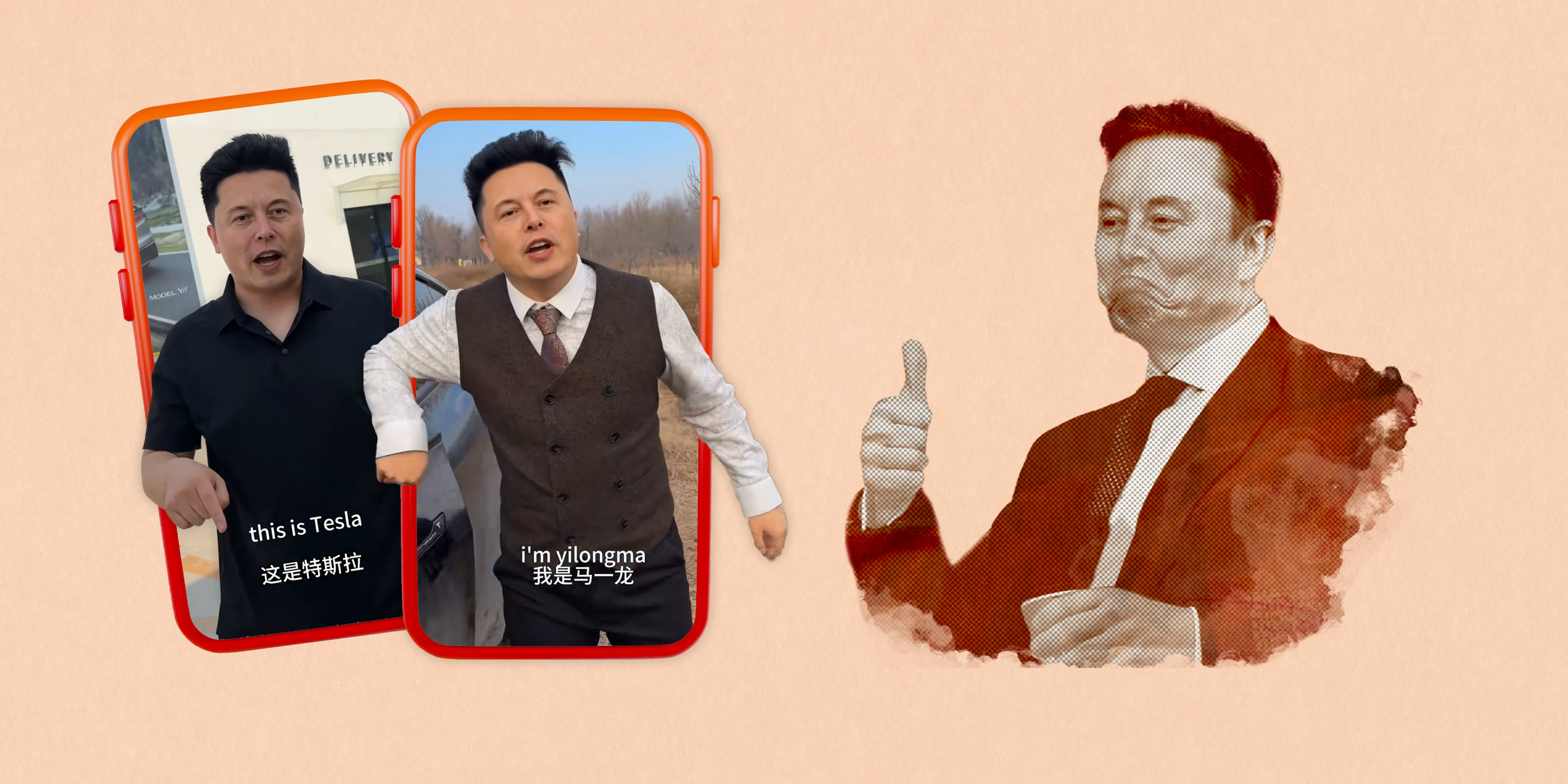
Welcome to China, Elon Musk. His Chinese Doppelgänger Is Calling.
In May, as U.S. President Donald Trump visited China alongside a delegation of tech executives, including Elon Musk, a Chinese lookalike of the South African entrepreneur stood outside a Tesla showroom and posted a video to Instagram. Looking directly into the camera, he addressed the then-billionaire: “Welcome to China, Elon Musk.”
The man on camera, who goes by Yilong Ma, first went viral on Douyin, China’s version of TikTok, in November 2020 for his uncanny facial resemblance to Musk. He peppers his videos with short, recognizable English catchphrases like “money,” “good,” and “I love you,” while performing a stylized Musk persona. Tailored three-piece suits, staged confidence, and carefully curated displays of wealth, from a black Tesla Model 3 to wads of dollar bills, help construct the image of a tech titan.
His resemblance is uncanny, his appeal is global, and his popularity is enduring. Yilong Ma is far from the first Chinese imitator of a foreign figure to catch the public’s eye, but his staying power suggests that his performances are more than just a surprisingly similar face. Whereas earlier doppelgängers — such as Chinese Barack Obamas — quickly faded from view, Yilong Ma and other more recent imitators are elevating their acting niche to a higher level.
As Musk became more politically visible in recent years, from acquiring Twitter and launching xAI to backing Trump’s reelection campaign, Yilong Ma’s performance evolved alongside Musk’s changing public image. His videos increasingly folded in symbols from Musk’s orbit: doge faces printed on shorts and repurposed into headgear, cardboard cutouts of Trump, and angular, Cybertruck-like vehicles parked in the background. As his celebrity grew, the clips eventually caught Musk’s attention, prompting the Tesla and SpaceX CEO to joke online that he, too, might be “partly Chinese.”
As such, Yilong Ma goes beyond the tired narrative often projected onto China of simple imitation and replication. His performance challenges the older idea of shanzhai, a Chinese term that literally means “mountain fortress” and has come to describe knockoff culture, low-cost imitation, and grassroots copying.
Ma is not simply producing a cheaper version of Musk. His videos show how copying can generate a different kind of value: affective, participatory, and social. The imitation works not because it replaces the original but because it gives viewers something to react to, joke about, debate, and share. His copy does not merely imitate power from below. It turns power into a form, something that can be worn, mispronounced, exaggerated, and played back to a global audience.
Unlike many content creators who turn viral fame into a full-time career, Ma has kept his daytime job in finance, and his videos rarely feature the embedded advertisements common across Chinese social media. In his first interview, conducted in 2023 with New York-based YouTuber Xiaomanyc, Yilong Ma described his videos as an attempt to bring “more joy and happiness” to viewers. Reflecting on his signature English delivery, he added with characteristic self-awareness: “English is difficult for me. Both Chinese and foreigners don’t understand my English.”
In a widely circulated series posted in June 2023, Ma stages a mock boxing match against a cardboard-masked Mark Zuckerberg. The videos riff on the bizarre moment when Musk and the Meta CEO publicly challenged one another to a cage fight in Las Vegas. Meta’s launch of Threads, a rival to X, helped spark the real-life challenge, which fizzled before anyone stepped into the ring. Yilong Ma, however, posted six clips reenacting the imagined showdown. Shirtless and theatrically aggressive, Ma’s Musk wins in every clip.
Under the short videos, viewers joke and riff in fractured English. “This is the real iylon, the one we see is the puppet,” one wrote, using an off-kilter spelling of “Elon.” Another admitted, “Idk why I love these videos so much.” For some viewers, Ma’s performance made Musk’s image feel less remote. “Because Elon doesn’t give of himself the way this guy does,” one commenter wrote. “A goofy, dorky side we might relate to.” Even Elon Musk joined the discussion. In August 2023, he commented on one of Ma’s videos: “Still don’t know if real or AI-generated.”
At a moment when AI can reproduce faces, voices, and gestures with increasing precision, Ma’s appeal does not depend on perfect imitation. In fact, it depends on what remains imperfect and embodied: the awkward English, the visible labor of performance, the comic timing, and the local context that turns imitation into a persona of its own. Once the copy becomes recognizable enough, its value begins to depend less on accuracy than on the distinctive character that emerges from its deviations.
Yilong Ma is not alone in this corner of China’s internet. Occasionally, he appears alongside Ryan Chen, a Chinese Trump impersonator whose performances rely less on facial resemblance than on behavioral precision.
With Chen, impersonation takes on a more explicitly functional form. By day, he works as a manager at an architecture firm. Online, his Trump impersonation has taken on another function: teaching English. Through videos branded as “Brother Ryan’s English (in Chinese),” Chen repurposes Trump’s speech patterns, vocabulary, and rhetorical style into language lessons, transforming political impersonation into a form of digital pedagogy.
Like Ma, Chen frames his performance less as parody than as a connection. He says he enjoys what he does because “laughter bridges barriers, even between superpowers.” With a combined following exceeding 5.5 million on Instagram, TikTok, and Douyin, Chen ranks among China’s most influential English-language creators.
In some videos, he adopts Trump’s speaking style to introduce tourism of his hometown of Chongqing, the sprawling megacity in southwestern China, in English, blending tourism promotion with online performance. The result is an unusual, if somewhat ironic, fusion of local branding and global political celebrity: a Chinese creator using the recognizable cadence of an American president to market a distinctly Chinese place.
Earlier this year, Chen traveled to the United States for the first time to attend CES, the world’s largest tech show. Throughout the trip, he documented the experience in a series of videos. He stayed at the Trump International Hotel in Las Vegas, fitting accommodation for someone who had spent years performing the sitting president online from Chongqing.
In one clip, Chen handed a pair of TCL earphones to a hotel security guard as a gift. Slipping into Trump’s cadence, he joked: “We need strong security for a country.” Gesturing around the hotel, he added, “I feel very safe living here, as safe as China. China is also very safe.”
The moment briefly shifted. Another hotel guest waiting for the elevator, referencing the Trump administration’s recent intervention in Venezuela, asked: “What about Venezuela?” Chen immediately stepped back from politics. “That’s not what I did,” he replied. “I’m just an impersonator.”
The response was not only a disclaimer. It was also a reminder of how this kind of shanzhai performance works. Its value and sustainability lie partly in the gap between resemblance and reality.
Figures like Trump and Musk are already unusually visible online, constantly posting and cultivating participatory public personas. What Ma and Chen’s impersonations show is how distant power can become familiar without becoming less powerful. In their videos, global political and tech elites are neither directly confronted nor simply copied. They are translated into accents, catchphrases, props, gestures, and comic performances, forms that ordinary viewers can recognize, repeat, and engage with. This is shanzhai not as failed authenticity, but as an alchemy that transmutes power into play.
(Header image: Visuals from VCG and Douyin, reedited by Sixth Tone)